Building a fashion brand involves much more than creating attractive designs. A successful clothing business depends on several moving parts, including product development, fabric selection, sampling, manufacturing, quality control, packaging, and timely delivery.
Among all these factors, choosing the right clothing manufacturer is one of the most important decisions a fashion brand can make.
The right manufacturing partner can help transform an idea into a commercially successful product. The wrong one can lead to inconsistent quality, production delays, communication problems, unexpected costs, and unhappy customers.
For emerging fashion brands, private labels, retailers, designers, and established businesses, finding a reliable apparel manufacturing partner is therefore not simply about comparing prices. It is about finding a manufacturer who understands your requirements and can consistently deliver according to your brand standards.
India has become an important sourcing and manufacturing destination for fashion businesses looking for flexible production capabilities, skilled workmanship, diverse fabrics, and competitive manufacturing solutions.
But with many manufacturers available, how do you know which one is right for your brand?
Let’s explore the key factors you should consider before choosing a clothing manufacturer.
1. Start by Understanding Your Manufacturing Requirements
Before contacting manufacturers, clearly define what you actually need.
Different fashion businesses have different manufacturing requirements. A startup launching its first collection may need help with everything from fabric sourcing to samples. An established brand may already have finalized designs and simply need a production partner.
Your requirements may include:
- Custom clothing manufacturing
- Private label manufacturing
- White label production
- Product development
- Fabric and material sourcing
- Sampling and prototyping
- Bulk production
- Custom packaging
- Labelling and branding
- Quality control
- Export support
You should also determine the type of clothing you want to manufacture.
For example, your brand may focus on:
- Men’s wear
- Women’s wear
- Kids’ wear
- Casual wear
- Shirts
- T-shirts
- Dresses
- Co-ord sets
- Jackets
- Trousers
- Shorts
- Occasion wear
- Resort wear
- Corporate clothing
Having a clear understanding of your product category will make it easier to identify manufacturers with relevant experience.
2. Look for Relevant Manufacturing Experience
Not every clothing manufacturer is suitable for every type of fashion product.
A manufacturer may be excellent at producing basic T-shirts but may not have the expertise required for structured jackets, detailed dresses, premium occasion wear, or specialized children’s garments.
When evaluating a manufacturer, look at their previous work and ask:
Have they manufactured products similar to yours?
Relevant experience matters because different garments require different approaches to:
- Pattern making
- Fabric selection
- Stitching
- Construction
- Finishing
- Measurements
- Trims
- Quality control
An experienced manufacturer can often identify potential production challenges before manufacturing begins.
For example, a particular fabric may look excellent in a design but behave differently during cutting, stitching, washing, or finishing. An experienced manufacturing team can help identify these issues during development instead of after bulk production.
3. Understand the Difference Between Private Label and Custom Manufacturing
One of the first decisions you should make is whether you need private label manufacturing or fully custom manufacturing.
Private Label Manufacturing
Private label manufacturing generally involves producing garments under your own brand name.
The manufacturer may help with:
- Existing garment styles
- Fabric selection
- Labels
- Tags
- Packaging
- Branding
- Minor customization
This can be a practical option for brands that want to launch products without developing every garment from scratch.
Custom Manufacturing
Custom manufacturing gives you greater control over the product.
You may provide:
- Your own designs
- Sketches
- Tech packs
- Measurements
- Samples
- Fabric specifications
- Branding requirements
The manufacturer then works with you to develop and produce the garment according to your specifications.
For brands focused on creating a distinctive identity, custom manufacturing can offer greater flexibility.
4. Evaluate the Manufacturer’s Product Development Process
A good clothing manufacturer should not only produce garments. They should ideally be capable of supporting the product development process.
Product development can involve several stages.
Design Review
Your design is reviewed to understand construction, materials, measurements, and finishing requirements.
Fabric Selection
The appropriate fabric is identified based on:
- Garment type
- Season
- Weight
- Texture
- Durability
- Appearance
- Target price
Pattern Development
Patterns are created according to the design and measurements.
Sampling
A prototype or sample is created so you can evaluate the garment before bulk production.
Revisions
If changes are required, the sample can be adjusted.
Production Approval
Once the final sample meets your expectations, the product can move into bulk manufacturing.
A structured product development process can significantly reduce mistakes during production.
5. Don’t Choose a Manufacturer Based Only on Price
Price is important, especially for new fashion businesses, but it should not be the only deciding factor.
A manufacturer offering the lowest price may not necessarily provide the best overall value.
A lower production price can sometimes come with compromises in:
- Fabric quality
- Stitching
- Finishing
- Quality control
- Packaging
- Communication
- Delivery timelines
Instead of asking only:
“What is your price per piece?”
consider asking:
“What exactly is included in the manufacturing cost?”
Compare factors such as:
- Fabric
- Trims
- Labels
- Packaging
- Sampling
- Pattern development
- Quality inspection
- Production
- Shipping preparation
This gives you a much clearer understanding of the actual value offered by a manufacturer.
6. Ask About Minimum Order Quantities
Minimum Order Quantity, commonly called MOQ, is another important consideration.
Some manufacturers prefer large production runs, while others are more flexible with smaller quantities.
For new fashion brands, smaller production quantities can be valuable because they allow the brand to:
- Test products
- Understand customer demand
- Reduce inventory risk
- Experiment with designs
- Improve products based on feedback
Established brands, on the other hand, may require larger production volumes.
Before starting the partnership, ask the manufacturer about their MOQ for each product category.
Also ask whether the MOQ changes depending on:
- Fabric
- Colour
- Size range
- Customization
- Printing
- Embroidery
- Product complexity
Understanding MOQ early can prevent misunderstandings later.
7. Pay Attention to Fabric and Material Sourcing
Fabric is one of the most important components of any garment.
The same design can feel completely different depending on the fabric used.
When choosing a manufacturer, ask whether they can help with fabric and material sourcing.
A capable sourcing team may help you identify materials based on:
- Quality
- Price
- Weight
- Texture
- Colour
- Availability
- Seasonal suitability
- Performance
For example, a summer collection may require lightweight and breathable fabrics, while winter products may require heavier materials and better insulation.
The manufacturer should understand that fabric selection is not simply a cost decision. It affects the appearance, comfort, durability, and overall perception of your brand.
8. Quality Control Should Be a Core Part of Production
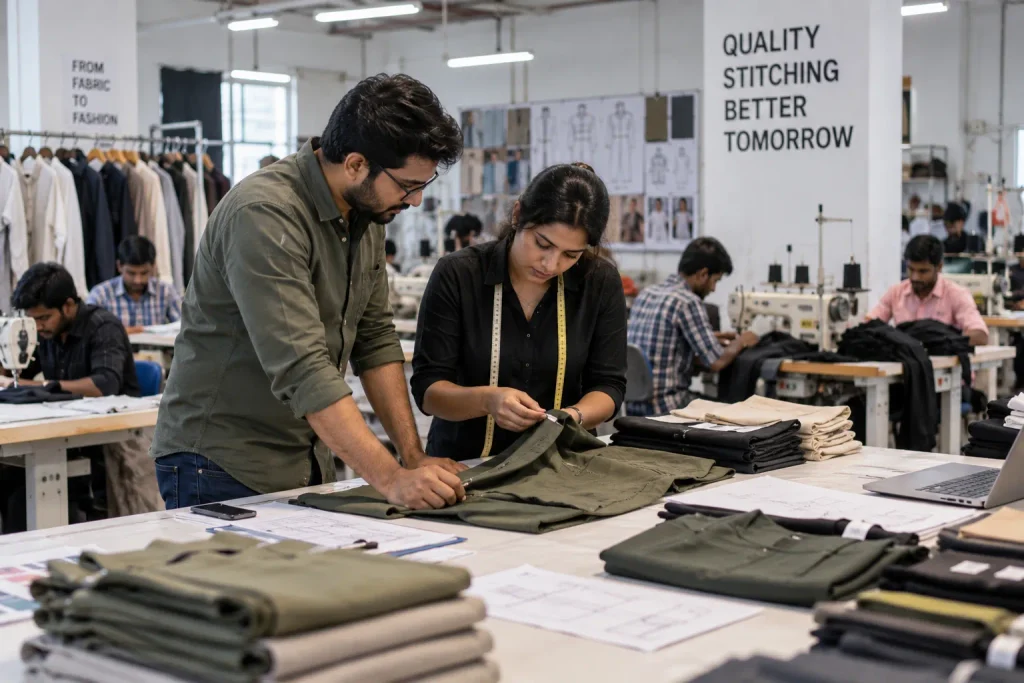
Quality control is essential for building customer trust.
Even small inconsistencies can become noticeable when products are manufactured at scale.
A professional manufacturing process should include quality checks throughout production.
These checks may cover:
- Measurements
- Stitching
- Fabric defects
- Colour consistency
- Seams
- Buttons
- Zippers
- Printing
- Embroidery
- Finishing
- Labelling
- Packaging
Ideally, quality should not be checked only after the entire order has been manufactured.
It should be considered throughout the production process.
Ask the manufacturer how they identify and handle defective pieces and what procedures they follow before an order is dispatched.
9. Communication Can Make or Break the Partnership
Manufacturing is a collaborative process.
Even a highly skilled manufacturer can become difficult to work with if communication is poor.
You should look for a manufacturer who communicates clearly about:
- Product requirements
- Sampling
- Fabric availability
- Production timelines
- Changes
- Costs
- Quality issues
- Delivery
Clear communication is particularly important when working with international clients.
Measurements, specifications, colour references, technical drawings, and production requirements need to be understood accurately.
A reliable manufacturing partner should be comfortable discussing these details and asking questions when something is unclear.
10. Check Production Capacity
Your manufacturing partner should be able to handle your current requirements while having enough capacity to support future growth.
A small fashion brand may initially require a relatively limited quantity. But if the collection becomes successful, production requirements can increase significantly.
Before choosing a manufacturer, understand their production capacity and scalability.
Ask:
- How many pieces can you produce?
- What is the typical production timeline?
- Can you handle repeat orders?
- Can production volume increase when required?
- How do you manage high-volume orders?
A manufacturer that can grow with your brand can become a long-term strategic partner rather than simply a supplier.
11. Sampling Is an Important Step
Never underestimate the importance of sampling.
A sample allows you to see how your concept translates into a physical garment.
During the sampling stage, evaluate:
- Fit
- Measurements
- Fabric
- Colour
- Stitching
- Construction
- Comfort
- Finishing
- Branding
- Overall appearance
If something is not right, communicate the required changes before bulk production begins.
It is much easier and less expensive to correct a design during sampling than after thousands of pieces have been produced.
A manufacturing partner should understand that your product represents your brand.
12. Look for a Manufacturer That Understands Your Brand
Your customers may never meet your manufacturer. They will judge your business through the products they receive.
That means every detail matters.
From fabric quality to stitching, labels, packaging, and finishing, the manufacturing process contributes to your brand experience.
A good manufacturer should therefore understand your:
- Target customer
- Price segment
- Product positioning
- Quality expectations
- Design language
- Brand identity
The more aligned your manufacturer is with your brand, the easier it becomes to maintain consistency.
13. Consider Location and Export Capabilities
If you are working with an international manufacturer, location can affect communication, logistics, shipping, and production management.
India offers fashion businesses access to a broad textile and apparel ecosystem.
For international brands, working with an Indian clothing manufacturer can provide access to:
- Diverse textile options
- Skilled garment production
- Flexible manufacturing
- Product development capabilities
- Private label services
- Export-oriented production
However, you should still evaluate the manufacturer’s ability to manage international requirements and documentation relevant to your project.
14. Ask the Right Questions Before Starting
Before finalizing a manufacturing partner, prepare a list of questions.
Some useful questions include:
- What types of garments do you manufacture?
- Do you offer private label manufacturing?
- Can you manufacture from my own designs or samples?
- Do you provide custom manufacturing?
- What is your MOQ?
- Can you help with fabric sourcing?
- Do you provide samples?
- What is your typical production timeline?
- How do you manage quality control?
- Can you support repeat orders?
- Do you provide custom labels and packaging?
- Can you manufacture for international brands?
The answers can help you understand whether the manufacturer is genuinely equipped to support your business.
15. Think Long-Term, Not Just About Your First Order
Your first production order is only the beginning.
If your brand performs well, you may need the same manufacturer for multiple collections and repeat production.
That makes long-term reliability extremely important.
A good manufacturing relationship can help you achieve:
- Consistent product quality
- Faster development
- Better communication
- Smoother repeat orders
- More predictable production
- Easier collection expansion
Instead of constantly searching for new suppliers, a reliable manufacturing partner can become part of your brand’s growth process.
Why India Is an Important Destination for Apparel Manufacturing
India has a long-standing textile and garment manufacturing ecosystem with access to a wide range of fabrics, production capabilities, skilled workers, and supporting industries.
For fashion brands, this can make India an attractive destination for both product development and garment production.
Delhi, in particular, provides access to a large business and manufacturing network, making it possible for brands to work with suppliers, sourcing partners, designers, production teams, and logistics providers.
For brands looking for a combination of design flexibility, manufacturing expertise, and brand-focused production, choosing an experienced Indian apparel manufacturer can be an effective option.
Finding the Right Manufacturing Partner
Choosing a clothing manufacturer should never be rushed.
Take the time to understand their capabilities, production process, quality standards, communication style, and approach to product development.
The best manufacturing relationship is not necessarily the one with the cheapest quotation.
It is the one that gives your brand confidence that your products will be developed and manufactured according to your expectations.
At MEAMI Fashion Exports, we work with fashion businesses looking for a manufacturing partner who can support their journey from concept to finished garment.
Whether you are developing a new collection, launching a private label, manufacturing custom garments, or expanding an existing clothing business, having the right production partner can make the process more efficient and reliable.
Your design represents your brand. Your manufacturing partner should help you deliver it at its best.