Starting a fashion brand is about more than creating great designs. Behind every successful clothing collection is a carefully managed process that turns an idea into a finished garment.
For fashion startups, designers, retailers, and established brands, managing this process internally can be challenging. Product development, fabric sourcing, sampling, garment production, branding, quality control, and packaging all require time, expertise, and reliable resources.
This is where private label clothing manufacturing becomes valuable.
Private label manufacturing allows a fashion business to create clothing under its own brand while working with an experienced manufacturer to manage the production process. Instead of investing in your own factory and production infrastructure, you can work with a manufacturing partner who understands how to develop and produce garments according to your requirements.
India has become an important destination for apparel manufacturing because of its established textile industry, skilled workforce, diverse fabric options, and growing manufacturing capabilities.
But before choosing a manufacturer, it is important to understand how private label clothing manufacturing actually works and what you should expect from the process.
What Is Private Label Clothing Manufacturing?
Private label clothing manufacturing is a production model where garments are manufactured for a business and sold under that business’s own brand name.
The manufacturer can support different stages of production depending on the requirements of the brand. This may include product development, fabric sourcing, pattern development, sampling, bulk manufacturing, branding, finishing, quality control, and packaging.
For example, imagine a fashion startup wants to launch its own women’s clothing collection. The brand may have its own designs and brand identity but does not have a manufacturing facility.
Instead of setting up production internally, the brand can work with a private label apparel manufacturer to develop and manufacture the collection.
The finished garments can carry the brand’s own labels, tags, colours, packaging, and other branding elements.
This gives the business control over its customer-facing brand while allowing an experienced manufacturing team to handle the production side.
Why Private Label Manufacturing Is Becoming Popular
The fashion industry is becoming increasingly competitive. Customers have access to thousands of clothing brands through e-commerce platforms, social media, marketplaces, and physical retail.
Because of this, brands need to focus on creating a clear identity and offering products that customers recognize and trust.
Building an entire manufacturing operation from scratch can take significant investment. A business would need production equipment, skilled workers, sourcing relationships, quality-control systems, storage, and production management.
Private label manufacturing provides a simpler approach.
A brand can focus on its designs, positioning, marketing, sales, and customer relationships while its manufacturing partner focuses on turning those products into finished garments.
This can be particularly useful for startups and growing fashion brands that want to enter the market without creating their own manufacturing infrastructure.
Private Label vs Custom Clothing Manufacturing
Private label and custom clothing manufacturing are often discussed together, but there is an important difference.
With private label manufacturing, a brand typically wants garments produced under its own brand identity. The products may be based on existing styles or developed according to the brand’s requirements.
Custom clothing manufacturing offers a higher level of product control. A brand can provide its own designs, sketches, samples, measurements, technical specifications, or tech packs and work with the manufacturer to develop the garment.
For fashion businesses with a strong design identity, custom manufacturing can be particularly useful because the final product can be developed around the brand’s exact vision.
In practice, many manufacturers provide both private label and custom manufacturing services, allowing brands to choose the production approach that best fits their collection.
Who Can Use Private Label Clothing Manufacturing?
Private label manufacturing can work for businesses at different stages of their fashion journey.
A new fashion startup may use it to launch its first collection without investing in a manufacturing facility. An online clothing business can use private label production to create products specifically for its e-commerce store.
Fashion designers can turn their designs into commercially produced garments, while retailers can develop exclusive products under their own private labels.
Established fashion brands can also work with external manufacturers when they need additional production capacity or want to expand into new product categories.
The model is equally relevant for international fashion businesses looking for apparel manufacturing partners in India.
Starting With Your Product Idea
Every clothing collection begins with a product idea.
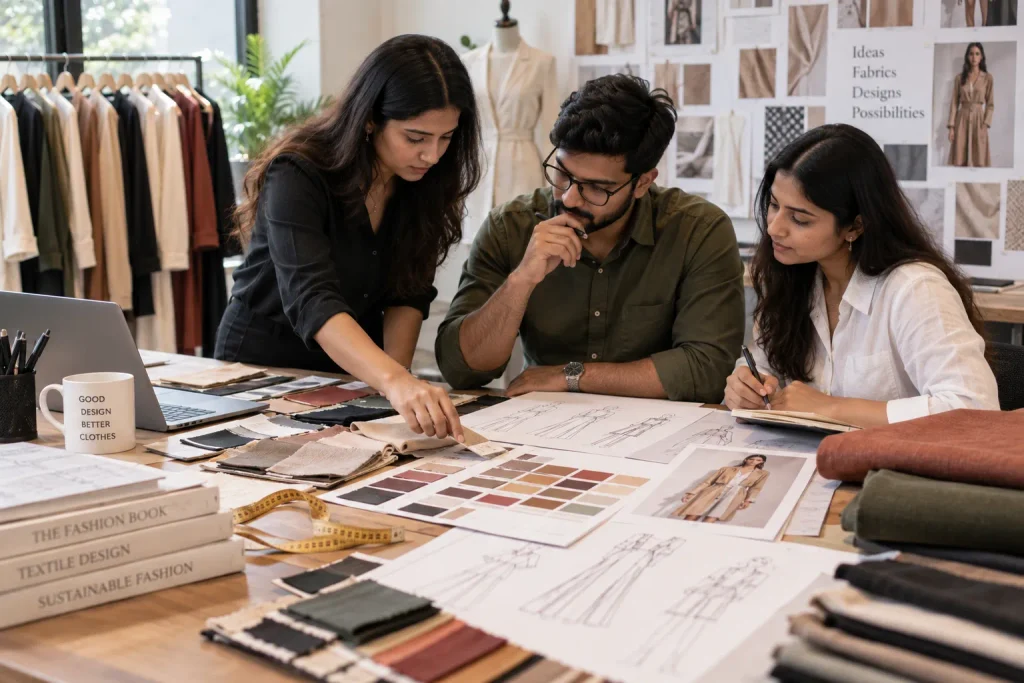
The idea could be a sketch, a mood board, a reference garment, a digital design, or even a simple concept describing what the brand wants to create.
At this stage, the manufacturer needs to understand the product clearly.
The brand should communicate the type of garment, intended customer, expected quality, approximate price positioning, fabric preferences, and any specific design requirements.
A manufacturer with product development experience can help identify what is required to move the concept toward production.
This is especially helpful for new brands that may have strong creative ideas but limited technical manufacturing experience.
Understanding Your Target Market
A garment should always be developed with its target customer in mind.
A premium fashion label may require refined fabrics, detailed construction, and high-quality finishing. A casual everyday clothing brand may prioritize comfort, durability, and cost efficiency.
Similarly, children’s clothing has different requirements from men’s or women’s fashion.
Understanding your market helps determine everything from fabric selection and garment construction to finishing and packaging.
A good private label clothing manufacturer in India should be able to understand these differences and work with the brand to develop products that are appropriate for its market.
Fabric Selection and Sourcing
Fabric is one of the most important decisions in garment manufacturing.
It affects how a product looks, feels, fits, and performs. The wrong fabric can change the appearance of an otherwise good design, while the right material can significantly improve the final garment.
Fabric selection depends on several factors, including the type of garment, season, target customer, desired quality, and price range.
For example, a summer collection may require lightweight and breathable fabrics, while structured garments may require materials with greater body and stability.
Working with a manufacturer that can assist with fabric sourcing can simplify this stage. Instead of searching for different suppliers independently, brands can explore suitable materials with their manufacturing partner.
Product Development and Sampling
Once the basic product requirements are established, the development process can begin.
Depending on the project, this may involve pattern development, measurements, construction details, fabric selection, trims, and other technical requirements.
The first sample is an important part of this process.
A sample gives the brand an opportunity to see how the design works as a physical garment. It allows the team to evaluate the fit, fabric, measurements, construction, colour, finishing, and overall appearance.
The first sample may not always be perfect. Adjustments are common during product development.
The brand may request changes to the length, fit, sleeves, neckline, fabric, stitching, buttons, or other details.
These revisions help bring the final product closer to the original vision.
Why Sampling Matters Before Bulk Production
Moving directly from a design to bulk production can create unnecessary risks.
A design may look perfect digitally but behave differently when produced in real fabric.
The sample stage gives the brand an opportunity to identify these issues before a larger quantity is manufactured.
It is also an opportunity to confirm that the manufacturer understands the design correctly.
Once the final sample has been reviewed and approved, it can become the main reference for bulk production.
This makes the sampling stage one of the most valuable parts of the private label manufacturing process.
Building Your Brand Into the Garment
Private label manufacturing is not simply about producing clothing. It is about producing clothing that represents your brand.
Brand identity can be integrated into the garment through labels, tags, embroidery, printing, packaging, and other details.
A simple garment can feel completely different when it has carefully considered branding and presentation.
For this reason, branding requirements should be discussed early in the manufacturing process rather than being treated as an afterthought.
The manufacturer should understand where the brand label should be placed, how the logo should appear, what type of tags are required, and how the finished products should be packaged.
From Approved Sample to Bulk Production
After the product is approved, the manufacturer can prepare for bulk production.
Materials are arranged, patterns are prepared, and the production process is organized according to the approved specifications.
The exact manufacturing process depends on the garment.
A basic T-shirt may have a relatively straightforward construction, while a detailed dress, jacket, or tailored garment may require considerably more stages.
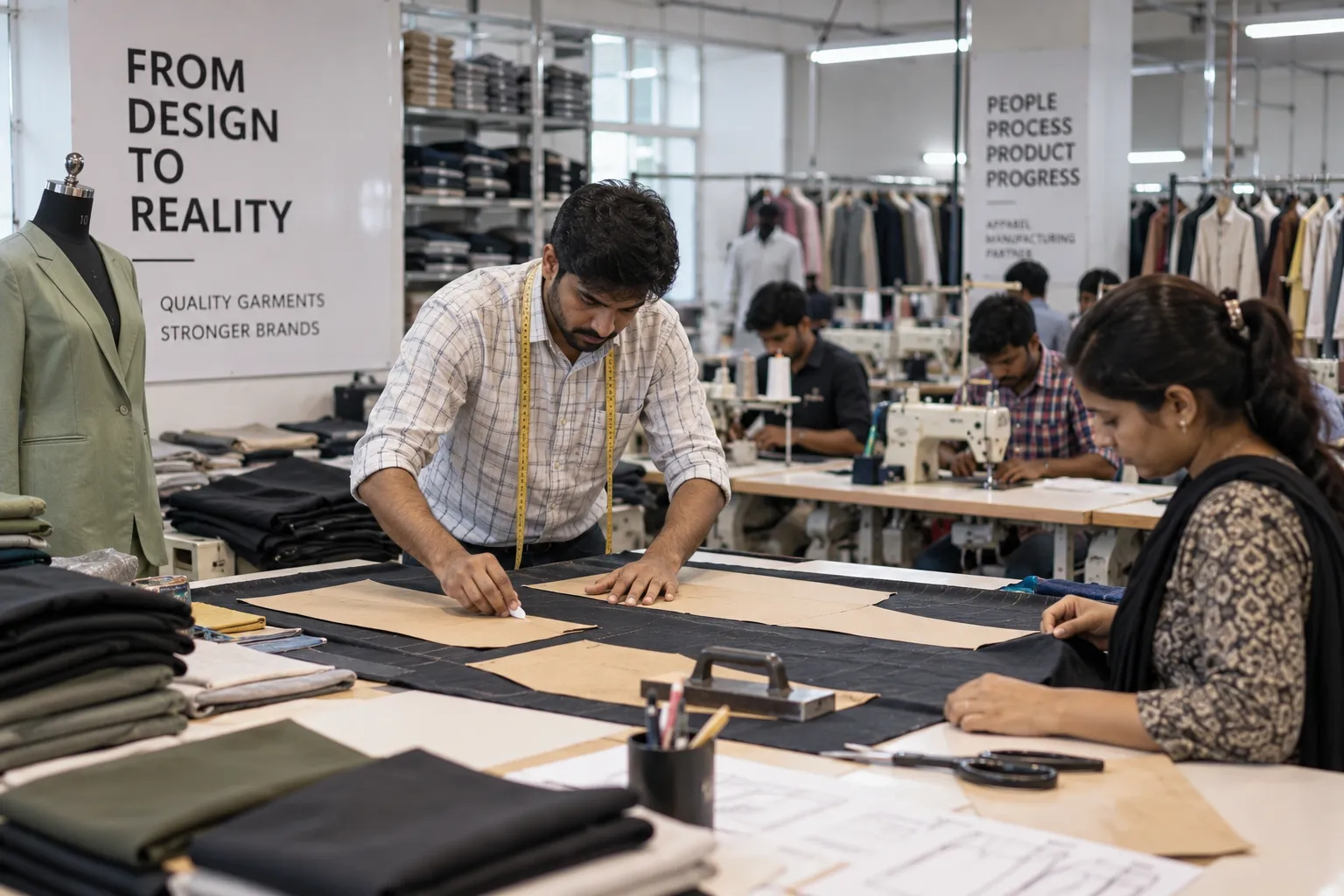
During production, the garment moves through cutting, stitching, assembly, branding, finishing, and inspection before it becomes a completed product.
Effective production planning is important because delays at one stage can affect the entire order.
Quality Control in Private Label Manufacturing
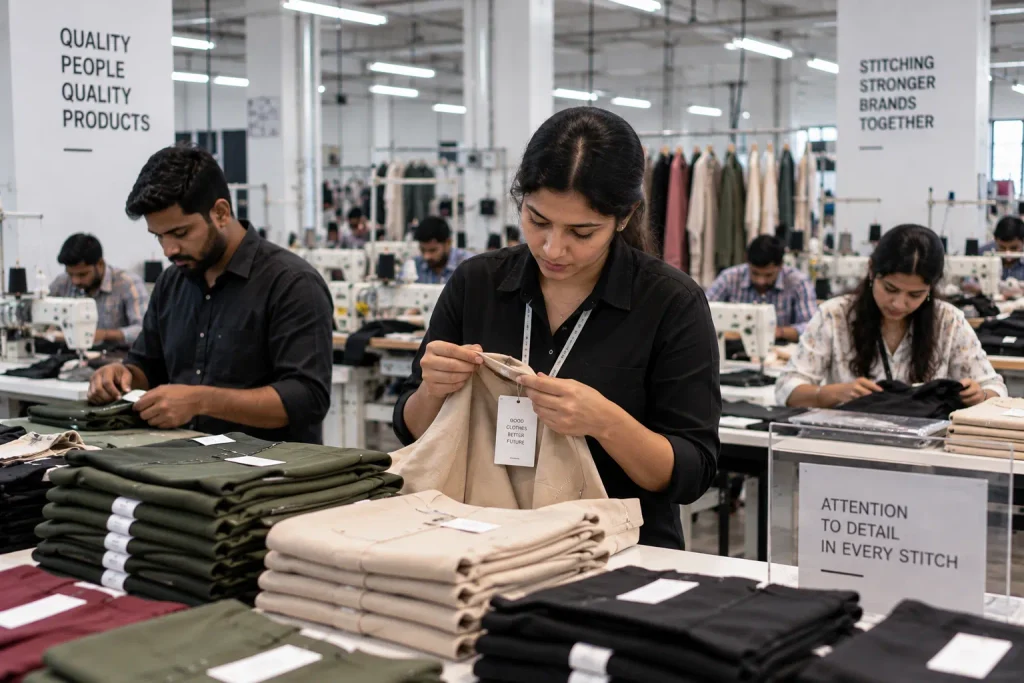
Quality control is essential for every fashion brand.
Customers do not see the manufacturing facility behind a garment. They judge the brand based on the product they receive.
If stitching is inconsistent, measurements are incorrect, fabric quality varies, or finishing is poor, the customer is likely to associate that experience with the brand itself.
Quality control should therefore be considered throughout production.
Garments can be checked for measurements, stitching, fabric defects, construction, branding, finishing, and overall consistency.
The approved sample can be used as an important reference to ensure that bulk production remains aligned with the product the brand originally approved.
The Importance of Consistency
For a growing fashion brand, consistency is just as important as quality.
Customers expect the same product standard when they purchase different colours, sizes, or future collections.
Consistency becomes especially important when a brand moves from its first small production run to larger quantities.
A reliable manufacturing process should be designed to maintain the approved specifications across the entire order.
This includes garment measurements, fabric appearance, stitching, branding, finishing, and packaging.
The goal is not simply to produce a large number of garments. It is to produce garments that consistently represent the brand.
Packaging and Final Presentation
The manufacturing journey does not necessarily end when the garment is stitched.
Packaging is also part of the product experience.
Depending on the brand’s requirements, finished clothing may include custom labels, hang tags, care labels, size information, individual packaging, or branded boxes.
For e-commerce brands, packaging can be particularly important because it becomes part of the customer’s first physical interaction with the product.
A carefully finished garment presented in professional packaging can create a stronger impression than a product that arrives without attention to presentation.
Understanding MOQ
One important question every fashion brand should ask a manufacturer is the Minimum Order Quantity, or MOQ.
MOQ refers to the minimum quantity a manufacturer is prepared to produce for a particular order.
The MOQ can vary depending on the product, fabric, colour, customization, and manufacturing requirements.
For startups, understanding MOQ is particularly important.
Ordering a very large quantity before understanding customer demand can create unnecessary inventory pressure. At the same time, extremely small production quantities may not always be practical for certain fabrics or manufacturing processes.
Discussing MOQ at the beginning allows the brand and manufacturer to establish realistic production expectations.
Choosing a Private Label Clothing Manufacturer in India
Choosing the right manufacturing partner requires more than comparing quotations.
Price is important, but it should be considered alongside manufacturing capability, quality, communication, product development, and reliability.
A suitable manufacturer should understand the type of garments you want to create and have the resources required to produce them consistently.
Look at their experience with similar products and ask how they handle sampling, fabric sourcing, quality control, branding, and production.
Communication should also be a major consideration.
A manufacturing partnership involves continuous communication between the brand and production team. Measurements, fabric specifications, samples, revisions, deadlines, and quality requirements all need to be clearly understood.
The right manufacturer should feel like a production partner rather than simply a supplier.
Questions to Ask Before Choosing a Manufacturer
Before starting production, it is useful to discuss the complete manufacturing process with your potential partner.
Ask about their experience with your product category, whether they provide private label and custom manufacturing, how they manage sampling, what their MOQ is, and whether they can assist with fabric sourcing.
You should also understand their quality-control process, production timelines, branding capabilities, packaging options, and ability to handle repeat orders.
These conversations can help you identify potential challenges before production begins.
Why India Is a Strong Choice for Apparel Manufacturing
India has a well-established textile and apparel industry supported by a broad network of fabric suppliers, garment manufacturers, skilled workers, and related production services.
This gives fashion brands access to a wide range of manufacturing possibilities.
For brands looking for apparel manufacturing in India, the country can provide opportunities across product development, fabric sourcing, sampling, private label production, custom manufacturing, and bulk garment production.
Delhi is also an important commercial centre with access to a large fashion and textile ecosystem.
For international brands, working with an experienced Indian manufacturer can provide access to manufacturing expertise while allowing the brand to maintain control over its product and identity.
Private Label Manufacturing for International Brands
The growth of global e-commerce has made it easier for fashion brands to work with manufacturing partners outside their home markets.
International brands can collaborate with Indian manufacturers to develop clothing collections according to their market requirements.
This can involve different sizing standards, fabric preferences, labelling requirements, packaging expectations, and quality specifications.
Clear communication becomes particularly important when the brand and manufacturer operate in different countries.
Detailed product information, approved samples, and consistent production processes help both sides stay aligned.
Building a Long-Term Manufacturing Partnership
The best manufacturing relationships often develop over time.
When a manufacturer becomes familiar with a brand’s product standards, fit preferences, fabrics, branding, and quality expectations, future collections can become easier to manage.
A growing brand may eventually need additional styles, larger production quantities, new colours, seasonal collections, or repeat orders.
Having a trusted manufacturing partner can make these changes easier to handle.
Instead of starting the production process from zero for every collection, the brand and manufacturer can build on their previous experience.
This creates a more efficient and reliable production relationship.
Common Mistakes Fashion Brands Should Avoid
One of the most common mistakes is choosing a manufacturer based entirely on the lowest price.
Manufacturing cost matters, but a low quotation does not automatically mean better value. Fabric quality, workmanship, finishing, communication, and reliability should also be considered.
Another common mistake is skipping the sample stage.
Even if a design appears straightforward, the physical garment can reveal issues that are difficult to identify digitally.
Brands should also avoid placing large orders without understanding their market demand, production requirements, and MOQ.
Most importantly, all specifications should be communicated clearly before production begins.
From Your Brand Idea to Your Finished Collection
Private label clothing manufacturing gives fashion businesses an opportunity to build their own products and brand identity without establishing an entire manufacturing operation themselves.
From the first product concept to fabric selection, sampling, branding, bulk production, quality control, and packaging, every stage contributes to the final result.
The key is choosing a manufacturing partner that understands your vision and has the capability to turn that vision into consistent, market-ready garments.
At MEAMI Fashion Exports, we work with fashion businesses looking for reliable apparel manufacturing solutions, including private label manufacturing, custom clothing manufacturing, product development, fabric sourcing, and garment production.
Whether you are launching a new fashion label, developing a seasonal collection, expanding an existing product line, or looking for a manufacturing partner in India, the right production process can help you move from concept to finished garment with greater confidence.
Build Your Brand With the Right Manufacturing Partner
Your brand begins with an idea, but the finished product is what your customer experiences.
That is why every detail—from fabric and fit to stitching, branding, finishing, and packaging—matters.
With the right private label clothing manufacturer in India, your ideas can move from initial concept to professionally manufactured garments that are ready for your market.
Your brand. Your vision. Your collection. Built for your market.